"Grow Curious, Stay Green."

🌈 Why Do Springtails Come in Different Colours? (White, Orange, Red, Blue & More)
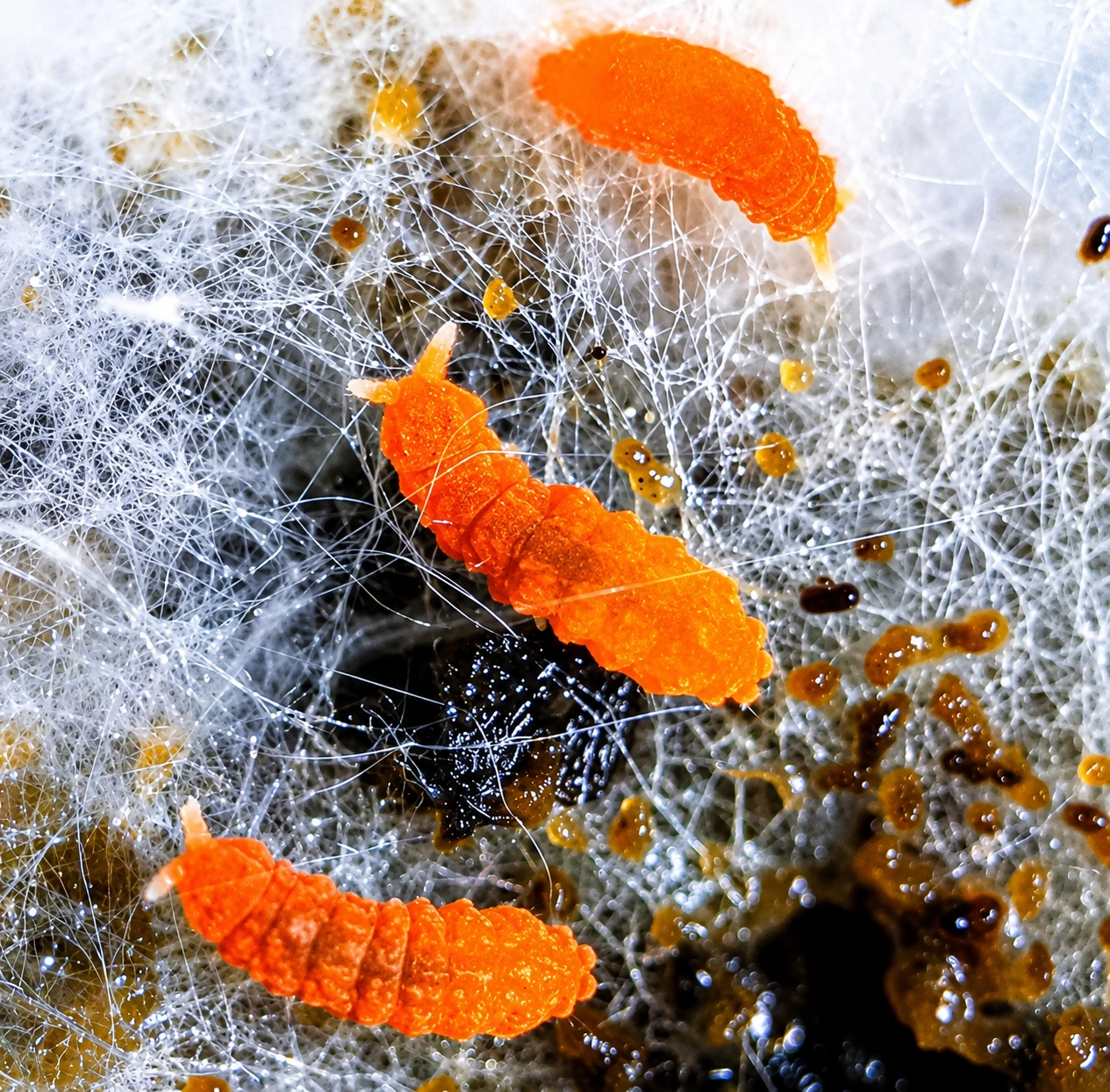
🌱 If you’ve ever peered closely into a thriving terrarium, you may have spotted tiny, jumping specks in white, orange, red, or even a shimmering blue-grey, scurrying across the moss and leaf litter. These are springtails — and their colours are far more than just a pretty accident of nature.
At TropicalZone, we get this question all the time from hobbyists building their first bioactive setup: “Why are some springtails white, while others are orange, red, or even blue? Does the colour actually mean anything?” It’s a great question, and the answer touches on genetics, pigment chemistry, diet, camouflage, and millions of years of evolutionary history packed into a creature that’s barely a couple of millimetres long.
In this deep-dive guide, we’ll walk through exactly why springtails come in different colours, take a close look at each major colour morph (including the fascinating and often-overlooked blue springtail), explain what colour does and doesn’t tell you about a culture, and help you decide which colour is right for your own terrarium, vivarium, or paludarium.
🔬 What Exactly Are Springtails?
Springtails belong to the order Collembola tiny, six-legged hexapods that are so ancient and so distinct from true insects that scientists now classify them in their own separate group entirely. Fossil evidence suggests springtail-like creatures have existed for well over 400 million years, making them one of the oldest land-dwelling arthropod lineages still thriving today. There are more than 8,000–9,000 described species worldwide, and researchers estimate there are thousands more yet to be formally identified, tucked away in soil, leaf litter, caves, mountain snowfields, and even along the edges of ponds and streams.
n the terrarium and vivarium hobby, springtails are best known as a “clean-up crew.” Alongside isopods, they quietly consume mould, fungal growth, uneaten food, decaying plant material, and general organic waste, helping to keep bioactive enclosures fresh, balanced, and self-sustaining. Without a clean-up crew, closed and semi-closed terrariums tend to build up mould and waste far more quickly, which can harm plants and any animals living inside.
Springtails are completely harmless. They don’t bite, sting, or damage healthy plants, and they pose no threat to humans, pets, or reptiles. If anything, they’re a benefit to have around even outside of terrariums, springtails in garden soil are considered a sign of healthy, biologically active earth. If you’re just getting started, Springtails for Terrariums from TropicalZone are a reliable, beginner friendly way to introduce a clean-up crew into a new bioactive build.
🧡 Did you know? Springtails get their name from a spring-loaded, tail-like appendage called a furcula, tucked under their abdomen and normally held in place by a small clasp called the tenaculum. When threatened, they release the furcula, catapulting themselves several centimetres into the air an astonishing distance for a creature that’s often smaller than a grain of sand.
A Quick Note on Taxonomy
Collembola is traditionally split into a few major groups based on body shape: the elongate-bodied Entomobryomorpha and Poduromorpha, and the rounded, globular-bodied Symphypleona and Neelipleona. This matters more than you might expect, because body shape and colour tend to travel together — globular springtails (often used as “globular” or “ball” springtails in the hobby) frequently show bolder, more saturated colours, while many elongate soil-dwelling species trend toward white, cream, or muted earth tones. Understanding which family a springtail belongs to can actually help predict both its likely colour and its ideal care conditions.
🎨 So, Why Do Springtails Come in Different Colours?
Understanding Why Do Springtails Come in Different Colours?
One common question that arises in this context is: Why Do Springtails Come in Different Colours? Understanding this can help enrich your terrarium experience.
Springtail colouration isn’t random it comes down to a combination of species genetics, pigment chemistry, diet, environment, life stage, and even the physical microstructure of their exoskeleton. Let’s unpack each of these factors in detail.
1. Species and Genetics 🧬
Just like different dog breeds carry different genetic blueprints for coat colour, different Collembola species (and even different populations within a species) carry different genetic instructions for pigment production. Some species, like the widely-cultured Folsomia candida, are naturally pale white or cream because their genetic makeup simply doesn’t code for strong pigment synthesis. Others, particularly many tropical species popular in the terrarium hobby, are genetically primed to synthesise carotenoid or melanin-based pigments, resulting in vivid orange, red, or deep blue-black colouration.
This genetic component is also why colour tends to be a fairly reliable though not perfect — way to identify which species (or at least which family) you’re looking at. A hobbyist who has kept several springtail cultures will often be able to make an educated guess at the species just from colour, size, and movement pattern, even without a microscope.
2. Pigment Chemistry: Not All Colour Is the Same 🧪
It helps to understand that “colour” in springtails (and in arthropods generally) can come from a few genuinely different biological sources:
Melanins — dark brown to black pigments, common in many temperate, soil-dwelling springtails, offering some protection against UV exposure near the soil surface.
Carotenoids — the same class of pigment responsible for the orange of carrots and the pink of flamingos. Springtails cannot synthesise carotenoids from scratch; they must obtain the raw building blocks through their diet and then metabolise them into the final pigment, which is deposited in their cuticle (outer shell) and internal tissues.
Ommochromes and other pigment classes — responsible for some of the reds, purples, and duskier tones seen in certain species.
Structural colour — not a pigment at all, but a visual effect created when microscopic ridges or layers in the cuticle scatter and reflect light in specific wavelengths. This is the same principle behind the shimmer on a butterfly’s wing or a beetle’s shell, and it’s believed to contribute to some of the more iridescent or “glassy” effects seen in certain springtail species, especially under strong light or magnification.
3. Diet-Linked Pigments 🍊
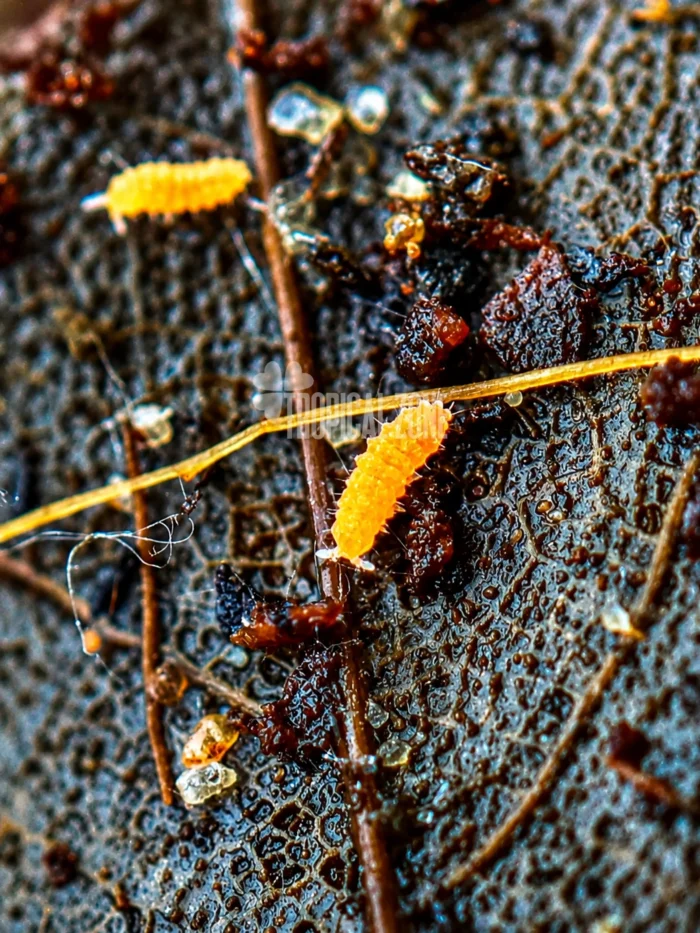
Diet plays a very real, measurable role in springtail colour, particularly for carotenoid-based hues. Springtails that feed on fungi, decaying plant matter, algae, and other organic material rich in carotenoid precursors tend to accumulate more of this pigment over their lifetime, which shows up as a stronger orange or red colouration. This is a major part of why Orange Springtails display such a vivid, warm hue compared to paler species their diet and their genetics work together to produce that saturated colour.
Interestingly, this diet-pigment link is well documented across the animal kingdom it’s the same underlying biological principle that makes farmed salmon pale pink unless their feed is supplemented with carotenoids, and why flamingos in captivity can lose their pink colouration if their diet isn’t carefully managed.
4. Environment and Camouflage 🍂
In the wild, colour very often functions as camouflage. Springtails living in leaf litter, tree bark, and topsoil tend to be brown, tan, or grey, blending into their surroundings to avoid predators such as predatory mites, ants, centipedes, and rove beetles. Species that live deeper in the soil profile where visual predation pressure is much lower and light barely penetrates often lose pigment almost entirely over generations of adaptation, appearing white, cream, or translucent. This is a classic example of convergent evolution seen across many soil-dwelling and cave-dwelling organisms, from springtails to certain beetles, spiders, and even fish.
Species living in more exposed, brightly lit microhabitats on moss, bark surfaces, or amongst colourful decaying leaves sometimes trend toward bolder, more saturated colouration instead, either because camouflage against a colourful, dappled background favours it, or because the selective pressure to hide is simply lower.
5. Life Stage and Moulting 🔄
Unusually among arthropods, springtails continue to moult throughout their entire adult lives, not just during their juvenile growth stages. Right after a moult, a springtail’s new exoskeleton is soft, thin, and often noticeably paler or more translucent than usual. Over the following hours to days, the cuticle hardens and pigment redevelops or redistributes, and the springtail returns to its typical colour. This means the very same individual can genuinely look different in colour depending on exactly where it sits in its moult cycle at the moment you’re observing it something worth keeping in mind before assuming a paler individual is unhealthy.
6. Age and Maturity 👶➡️🧓
Juvenile springtails are frequently paler and less pigmented than fully mature adults of the same species, since pigment tends to build up and deepen with each successive moult as the animal matures. A culture that looks like it has “mixed colours” is often simply showing a healthy age spread — tiny, translucent juveniles alongside darker, fully pigmented adults rather than representing multiple species.
🌈 Common Springtail Colours & What They Mean
Below is a quick-reference chart covering the most commonly seen springtail colours in the bioactive hobby, what typically causes each one, and what it means for your terrarium.
| Colour | Typical Cause | Terrarium Notes |
|---|---|---|
| ⚪ White | Low pigment production; often soil-dwelling species (e.g. Folsomia candida) | Classic, hardy, easy to culture — great starter species |
| 🟠 Orange | Carotenoid pigment accumulation; tropical species | Highly visible, adds vibrant colour contrast against dark substrate |
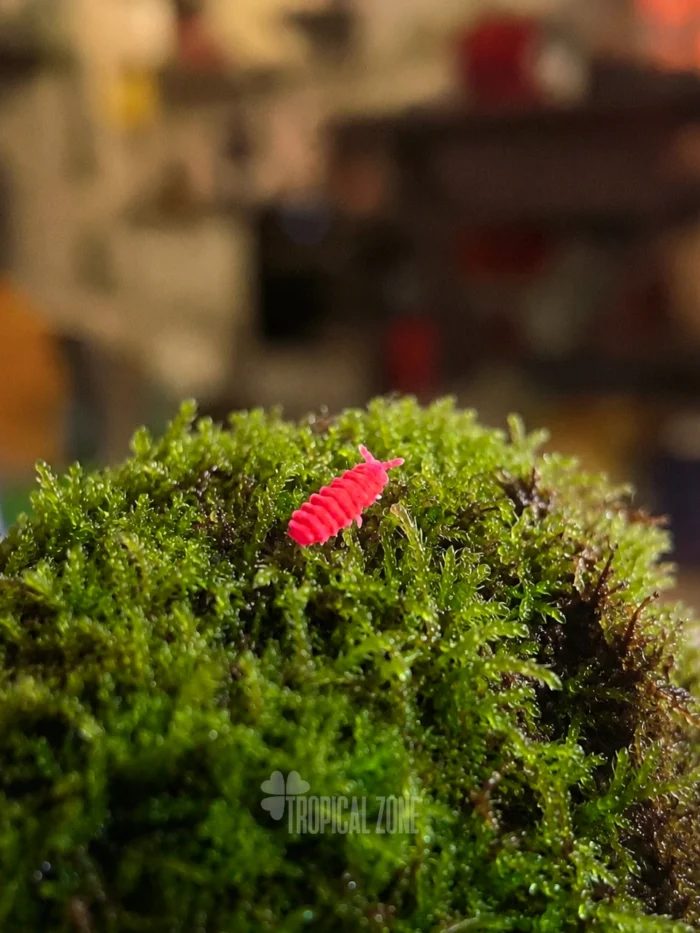
| 🔴 Red / Pink | Stronger carotenoid/pigment expression; warm tropical origin | Eye-catching “jewel” springtails; popular in display terrariums |
| 🔵 Blue | Species-specific pigmentation, often in the Hypogastruridae family | Extremely small, subtle, best appreciated under magnification |
| 🟤 Grey / Tan / Brown | Camouflage adaptation to leaf litter and soil environments | Often temperate species; blend naturally into substrate |
| 💜 Lilac / Soft Purple | Muted pigment blend, temperate species | Gentle, understated colour; good for mixed clean-up crews |
| ⚫ Black / Dark Grey | Strong melanin pigmentation | Common in temperate and surface-dwelling species; good UV tolerance |
| 🟡 Yellow / Albino | Reduced or altered pigment expression | Rare, pale globular species; visually striking against dark soil |
Shop Orange Springtails →
Spotlight: Blue Springtails — The Hobby’s Hidden Gem
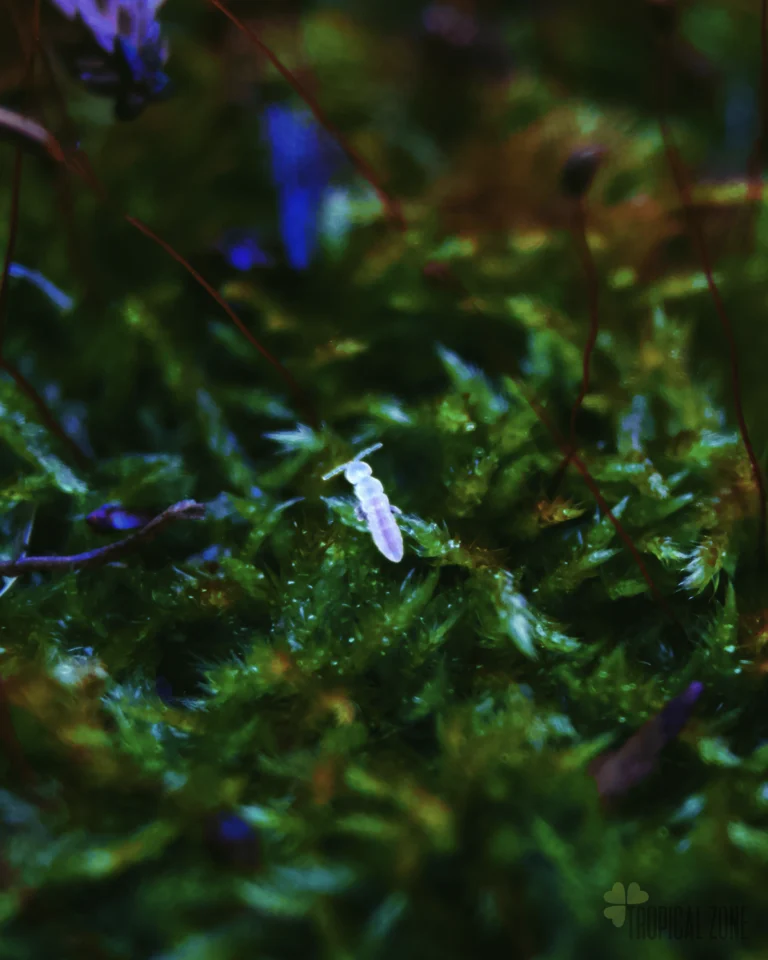
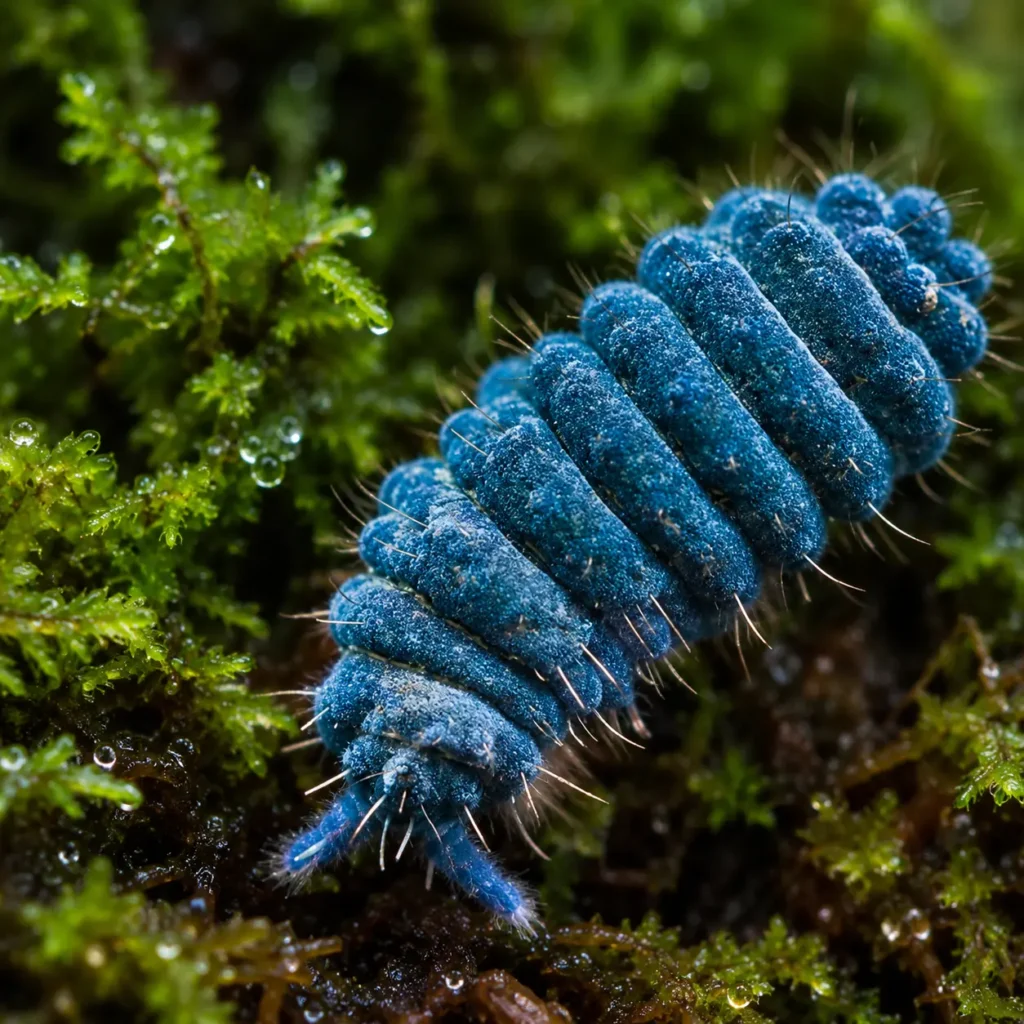
Of all the colour morphs available to bioactive hobbyists, blue springtails are probably the least talked about — and one of the most fascinating once you actually get to know them. Unlike the bold, unmistakable orange or red springtails that catch your eye the moment you glance into a terrarium, blue springtails tend to be genuinely tiny and subtle, often requiring a bit of patience (and sometimes a hand lens or phone macro camera) to properly appreciate.
What Species Are “Blue Springtails”?
In the hobby, “blue springtail” most commonly refers to small species within the family Hypogastruridae, sometimes sold under names like “Tiny Blue Springtails.” These are among the smallest springtails commonly kept in captivity, often maxing out at less than a millimetre in length as adults. Another species occasionally associated with a blue colour morph is Proisotoma minuta, sometimes marketed as a “Blue Podura Springtail,” valued for nutrient cycling in damp, enclosed setups.
What Do They Actually Look Like?
Colour descriptions for these species typically range from a deep blue, to blue-grey, to a dark slate tone — and under magnification, many keepers describe them as having a slightly “fuzzy” or textured appearance, quite different from the smooth, glossy look of larger orange or red species. Because their size is so small, the colour itself can be genuinely difficult to see with the naked eye; many new keepers assume their culture is empty or has crashed, only to discover thriving activity once they look closely at the substrate surface, the container walls, or areas of standing moisture with a torch or magnifier.
🔍 Keeper’s tip: If you’ve picked up a culture of blue springtails and can’t spot any movement at first, don’t panic. Their extremely small size means they’re frequently missed on a casual glance. Check damp surfaces, the underside of the lid, and areas near food sources with a bright light and, if possible, a magnifying glass or your phone’s macro camera mode before assuming the culture didn’t survive shipping.
Why Keep Blue Springtails?
Despite or perhaps because of their diminutive size, blue springtails have a genuine niche in the bioactive hobby:
Fine substrate access: Their tiny size lets them work through very fine substrates, dense moss mats, and tight leaf litter pockets that larger springtail species might struggle to penetrate.
Low visual disruption: For keepers who want a functional clean-up crew without a lot of visible “bug traffic” on display, blue springtails are far less conspicuous than large orange or red species.
Safe for tiny livestock: Their small size means they won’t bother or compete meaningfully with very small reptile, amphibian, or invertebrate tankmates, since they don’t take up much space or resources.
High humidity specialists: Many Hypogastruridae species do particularly well in consistently moist, humid microhabitats, making them a strong pairing for closed terrariums, moss-heavy paludariums, and isopod or springtail culture maintenance setups.
Care Considerations for Blue Springtails
Blue springtails should generally be treated as high-humidity microfauna. They do best with consistent moisture, a reliable food source (yeast, fish flake, or specialised springtail food work well), and good airflow to prevent mould from overwhelming the culture. Because of their small size, overcrowding and waste build-up can happen faster than expected in a small container, so keeping an eye on substrate condition and refreshing food regularly will help the culture stay healthy and productive.
If you’re building a bioactive terrarium and want a springtail species that works quietly behind the scenes without drawing attention away from your plants and hardscape, blue springtails are well worth considering alongside, or instead of, more visually bold colour morphs.
🧫 Does Colour Affect How Well Springtails Work?
Here’s the good news: colour by itself has no direct impact on how well a springtail cleans up your terrarium. Whether white, orange, red, or blue, springtails perform the same essential ecological job breaking down mould, decaying leaves, leftover food, fungal growth, and general organic waste to keep your bioactive setup fresh and self-sustaining.
The real differences between colour morphs usually come down to the species behind that colour, rather than the pigment itself. Things like body size, reproduction speed, temperature preference, humidity tolerance, and substrate-burrowing ability vary far more by species and family than by hue. For example:
Larger tropical species (often orange, red, or pink) tend to reproduce a little more slowly but are highly visible and efficient at handling larger volumes of waste.
Smaller species (often white or blue) reproduce quickly and can access tighter spaces, but individual specimens process comparatively less material.
Temperate, earth-toned species (grey, tan, brown, black) are often prized for their hardiness and tolerance of fluctuating conditions rather than for their appearance.
So when choosing a springtail culture, it’s worth thinking of colour as a helpful visual identifier for a species a bit like a name tag rather than a functional feature in its own right.
🌿 Practical tip: Coloured springtails like Orange, Red, or even Blue are especially popular for open or display terrariums, since their colour and behaviour become part of the visual experience — turning the “clean-up crew” into an engaging feature rather than a hidden background worker.
🩺 Can Colour Indicate a Springtail’s Health?
Colour changes can sometimes offer useful clues about a culture’s condition, though it’s important not to jump to conclusions based on colour alone:
Consistent, vibrant colour across most of the culture usually signals a healthy, well-fed population going through normal life cycles.
Paler-than-usual individuals scattered through an otherwise healthy culture likely just moulted recently or are juveniles this is completely normal and nothing to worry about.
A culture turning uniformly duller, or showing greatly reduced numbers and activity alongside colour changes, can point to underlying substrate issues such as excessive dryness, mould overload, ammonia build-up from waste, or contamination worth investigating humidity levels and substrate freshness rather than treating colour as the primary symptom.
A sudden “washed out” appearance across an entire culture is occasionally reported after a mass synchronised moult, particularly in younger cultures, and usually resolves within a day or two as the population’s cuticles harden back up.
As a general rule, it’s more useful to judge culture health by activity level, population density, and substrate condition than by colour alone. A slightly paler culture that’s still moving, feeding, and reproducing is almost always perfectly healthy.
🏡 Choosing the Right Colour for Your Terrarium
Since colour doesn’t fundamentally change function, choosing a springtail colour often comes down to a combination of personal aesthetic preference and a few practical considerations tied to the specific species behind that colour.
Consider Your Terrarium Style
Closed or dark-substrate terrariums: White springtails (like Folsomia candida) work extremely well here and are among the easiest species to maintain long-term, making them a great choice for beginners.
Open display terrariums & paludariums: Orange or Red springtails add a beautiful, highly visible pop of colour as they move across moss and leaf litter, turning routine clean-up activity into an engaging visual feature.
Minimalist or “hidden clean-up crew” setups: Blue or small white species work quietly in the background without drawing much visual attention, ideal if you want function without visual clutter.
Dart frog and reptile enclosures: Larger tropical coloured species are often preferred for their slightly bigger size and visual appeal, doubling as both a decorative and functional addition, and occasionally serving as an incidental feeder for very small livestock.
Consider Your Substrate and Humidity
Different species (and therefore colours) have different substrate and humidity preferences. Tropical coloured species such as Orange, Red, and Pink generally need consistently warm, humid conditions and will struggle with dry-outs. Temperate species often grey, tan, or white tend to tolerate a wider range of humidity and temperature fluctuations. Blue springtails, being mostly Hypogastruridae, lean toward the high-humidity end of the spectrum and do best in consistently moist microhabitats.
Consider Mixing Species
Many experienced hobbyists intentionally combine two or more springtail colour morphs — for example, a visible orange or red species on the surface alongside a smaller white or blue species working through the deeper substrate layers. This creates a more resilient, multi-layered clean-up crew that covers a broader range of microhabitats within the same enclosure, while also giving you a more visually varied and interesting terrarium to observe. Pairing springtails with a good isopod clean-up crew is another popular way to cover both surface and substrate-level waste at once.
🐾 Ready to Add Colour to Your Bioactive Setup?
Browse healthy, live springtail cultures on TropicalZone — carefully packed and delivered Pan India.
🟠 Orange Springtails 🔴 Red Springtails 🌿 View All Springtails
🚫 Common Myths About Springtail Colour
Colour is one of the most misunderstood aspects of springtail-keeping. Let’s clear up a few persistent myths.
Myth 1: “Brighter colour means a healthier or stronger springtail.”
Not necessarily true. Colour intensity is mostly a species and diet trait, not a direct health score. A pale white culture can be just as vigorous and productive as a vividly orange one — they’re simply different species with different natural pigmentation.
Myth 2: “Springtails change colour to match their environment, like a chameleon.”
Springtails do not actively change colour in real time the way a chameleon does. Colour is largely fixed by genetics, though it can shift gradually across generations through diet and environmental adaptation, or temporarily around moulting — but you won’t see an individual springtail actively shift its own colour to blend into a new background within its lifetime.
Myth 3: “All coloured springtails are the same species, just different morphs.”
In most cases, different colours actually represent genuinely different species or even different families altogether, not simply colour variants of one universal “springtail.” An Orange Springtail and a Blue Springtail are typically as different from each other, biologically, as two different species of ant.
Myth 4: “Darker or blue springtails are more dangerous or aggressive.”
All springtails commonly available in the hobby, regardless of colour, are harmless detritivores. None of them bite, sting, or pose any risk to plants, pets, or people. Darker or blue colouration is purely a matter of pigment biology, not behaviour or temperament.
📷 How to Observe (and Photograph) Springtail Colours
Because most springtails are so small, appreciating their colour properly often takes a little technique:
- Use raking light: Shine a torch or phone flashlight at a low angle across the substrate surface rather than straight down — this makes small, pale, or blue species much easier to spot as they cast tiny shadows and catch the light.
- Check damp, high-contrast surfaces: Springtails often gather on damp glass, cork bark, or leaf litter edges where colour contrast against the background makes them easier to see.
- Go macro: A basic macro lens attachment for a smartphone, or even a simple magnifying glass, transforms the experience of observing tiny species like blue or white springtails, revealing detail invisible to the naked eye.
- Be patient in the morning or evening: Many springtail species are more active during cooler, more humid periods of the day, which can make colour and movement easier to observe.
🌍 Springtail Colour in the Wild: An Ecological Perspective
It’s worth stepping back for a moment to appreciate just how much ecological pressure has shaped the colours we see in the terrarium hobby today. In their natural habitats, springtails sit fairly low on the food chain, making them a target for a surprisingly wide range of predators: predatory mites, rove beetles, centipedes, spiders, ants, and even some fungi that actively trap and consume them. Colour, in this context, is rarely decorative — it’s a survival tool shaped over countless generations.
Researchers studying soil ecosystems have long noted a general pattern sometimes referred to as the “pigmentation-habitat gradient” in soil arthropods: species living at or near the surface, exposed to light and visual predators, tend to be more heavily pigmented, while species that have adapted to live deep within the soil profile — where there’s no light and predation is dominated by touch and scent rather than sight — tend to lose pigment over evolutionary time. This is the same broad pattern responsible for the pale, often colourless appearance of many cave-dwelling and deep-soil invertebrates around the world, springtails included.
This gradient explains a lot about the colours available in the hobby today. Species like Folsomia candida, which naturally inhabit deeper soil layers, arrive in captivity already predisposed to a pale white appearance. Meanwhile, tropical surface and leaf-litter dwelling species — the ones typically sold as Orange, Red, or Pink springtails — carry the bold pigmentation their wild ancestors needed to survive in bright, exposed rainforest floor environments, filtering dappled sunlight through a dense canopy.
Regional Diversity Across India and the Tropics
India’s warm, humid climate across much of the country provides an excellent natural environment for tropical Collembola species, which is part of why tropical, brightly-coloured springtails tend to establish and thrive so readily in Indian terrariums and bioactive setups compared to some cooler, drier climates elsewhere in the world. Local leaf litter, humid monsoon conditions, and generally warm year-round temperatures across much of the country create conditions fairly close to the natural tropical habitats many of these vividly coloured species originally evolved in — one of the reasons tropical springtail cultures often do so well once established in Indian terrarium setups.
Why This Matters for Hobbyists
Understanding the ecological backstory behind springtail colour isn’t just trivia — it has a genuinely practical payoff. Knowing that brightly coloured tropical species evolved for warm, humid, surface-level environments tells you immediately that they’ll need consistent warmth and moisture to thrive in captivity. Knowing that pale species evolved for deeper, more stable soil conditions tells you they’ll likely tolerate a wider range of surface conditions but may prefer to stay buried rather than roam visibly across the top of your substrate. In other words, colour offers a genuine, evolution-backed hint about the care a species is likely to need — even before you’ve read a single care sheet.
Frequently Asked Questions ❓
Are orange, red, or blue springtails a different species from white ones?
Usually yes colour differences typically reflect genuinely different Collembola species or families, not just variation within one universal species.
Will springtails change colour over time in my terrarium?
Individual springtails generally keep their species-typical colour throughout their life, though they may look paler briefly after moulting. Colour is largely fixed by genetics and diet rather than changing to match the terrarium environment.
Do coloured springtails need different care than white ones?
Care requirements mostly depend on species (tropical vs. temperate, and family) rather than colour itself. Always check the specific humidity, temperature, and substrate needs of the particular species you buy.
Is it safe to mix different coloured springtails in one terrarium?
Generally yes — many hobbyists intentionally mix species for a more resilient, multi-layered clean-up crew, though one species may eventually become more dominant than others over time depending on conditions.
Why can’t I see any blue springtails in my new culture?
Blue springtails, especially Hypogastruridae species, are extremely small often under a millimetre as adults. Check closely with a bright light and, if possible, a magnifier before assuming the culture is empty; they’re frequently just difficult to spot rather than genuinely absent.
Do blue springtails work as well as orange or red ones?
Yes. All commonly kept springtail species regardless of colour perform the same core role of breaking down waste, mould, and decaying matter. Blue springtails are particularly well suited to fine substrates and consistently humid microhabitats.
What’s the rarest springtail colour?
Colours like blue, lilac, and true yellow/albino morphs tend to be less commonly available in the hobby compared to the widely cultured white and orange species, partly because they’re harder to culture at scale and partly because demand has historically focused on more visually bold colours.
Can I keep multiple colours of springtails together with isopods?
Yes, springtails of any colour generally coexist peacefully with isopods and most other common bioactive clean-up crew species, since they occupy slightly different ecological niches within the same enclosure.
🌿 Final Thoughts
Springtail colour is one of those small details that turns out to have a genuinely rich story behind it genetics, pigment chemistry, diet, camouflage, moulting cycles, and millions of years of evolutionary fine-tuning, all packed into a creature you might otherwise overlook entirely. Whether you’re drawn to the classic reliability of White Springtails, the vibrant visual punch of Orange and Red species, or the quiet, understated charm of Blue Springtails working away in the background, understanding what drives their colour helps you make a more informed choice for your specific bioactive setup.
Whatever colour you choose, springtails remain one of the simplest and most rewarding additions to a bioactive terrarium quietly working behind the scenes (or, in the case of Orange, Red, and Blue springtails, right out in the open once you know where to look) to keep your tiny ecosystem thriving. 🪱🐛🐜🕷🪰
🔗 Related Products & Reads on TropicalZone